Spain: Six measles cases have been confirmed in Mallorca in unvaccinated persons, representing the first cases reported in the Balearic Islands in 2026. The outbreak was identified on 7 August and linked to a paediatric tourist from another European country who attended the emergency department at Son Espases Hospital on 19 July. Secondary cases developed symptoms from late July onwards.
Sweden: On 17 Aug 2026, Swedish health authorities reported 19 measles cases linked to the Urkult festival in Näsåker (30 Jul–1 Aug), mostly among children under 18 years. Cases have been reported across several Swedish regions. As the festival attracted visitors from Sweden and other EU countries, further spread is possible.
Measles outbreaks are increasing worldwide.
Measles spread quickly and can be dangerous - protection is simple: get vaccinated!
Swiss recommendations: All persons born after 1963 who have no documented protection against the infection (antibodies or 2 documented vaccinations) should be vaccinated twice with MMR vaccine at one-month interval. In the event of an epidemic in the region or contact with a measles case, vaccination is recommended from the age of 6 months.
A cluster of Andes hantavirus infections linked to the Dutch-flagged cruise ship MV Hondius in the South Atlantic has resulted in multiple cases among passengers and crew from several countries. The outbreak involves Andes virus (ANDV), the only hantavirus known to cause limited person-to-person transmission, typically through close and prolonged contact.
Updates on new reported cases between 8 and 15 May 2026:
New cases - three new cases after the after evacuation from the cruise ship:
Total cases:
Other news:
Additional cases among cruise ship passengers remain possible due to the long incubation period of hantavirus infection, which can last up to 6–8 weeks. However, current response measures — including quarantine of disembarked passengers, rapid isolation of suspected cases, and contact monitoring — are expected to reduce the risk of further transmission.
Hantaviruses are rodent-borne zoonotic viruses transmitted to humans primarily through contact with contaminated rodent urine, droppings, or saliva. Human infections are rare but can cause severe and sometimes fatal disease.
Two main clinical syndromes are associated with hantavirus infection:
Transmission: Most hantaviruses are associated with specific rodent reservoir species that carry the virus without apparent illness. Human-to-human transmission is not typically and has only been documented with Andes virus in South America, primarily among close and prolonged contacts. Exposure risk increases during activities that disturb rodent-contaminated environments, such as cleaning enclosed spaces, farming, forestry work, or sleeping in rodent-infested dwellings.
Symptoms usually begin 1–8 weeks after exposure and include fever, headache, myalgia, abdominal pain, nausea, and vomiting.
Diagnosis can be difficult in the early stages because symptoms overlap with influenza, COVID-19, leptospirosis, dengue, viral pneumonia, and sepsis Confirmation relies on serology, especially IgM or rising IgG titres, and RT-PCR during acute illness.
Treatment: There is no licensed specific antiviral treatment or vaccine. Management is supportive, with close monitoring and treatment of respiratory, cardiac, and renal complications. Early recognition and access to intensive care when needed are essential to improve survival.
The risk to the general population is considered very low, while the risk for cruise ship passengers is assessed as moderate. Of note: Even if transmission from evacuated passengers occurs, widespread community spread is unlikely, as Andes virus (ANDV) does not transmit easily and infection prevention measures are in place.
Travel in areas where hanta virus is: Very low risk for travellers.
As of March 2026, mpox transmission continues globally across all clades, with clade Ib now confirmed for the first time in Argentina, Ecuador, Austria, the Central African Republic, Russia and Singapore and community transmission documented in five European countries (Austria, Belgium, Portugal, Spain, and the UK).
Sustained community transmission in Madagascar (clade Ib), Pakistan.
DRC Ministry of Health officially declares the end of the mpox epidemic as a national public health emergency on April 2, 2026.
A recombinant clade Ib/IIb strain has been detected in two travelers, with evidence suggesting wider circulation than currently documented (see WHO).
End of March, EMA’s committee for human medicines has issued a recommendation that Tecovirimat SIGA should not longer be used for the treatment of mpox (see EMA).
See also WHO global trends.
Risk very low for general populations but moderate for at risk groups.
Follow recommendations issued by local health authorities.
Since the beginning of 2025, and as of 20 August 2025, nine countries in Europe have reported human cases of West Nile virus infection: Albania, Bulgaria, France, Greece, Hungary, Italy, Romania, Serbia and Spain. Currently, 67 areas are known to be affected.
For updates, see ECDC LINK.
The following precautions are recommended:
If you have visited a West Nile fever transmission area, do not donate blood for at least 28 days after returning.
Germany: On 3 July 2025, German public health authorities reported detections of circulating vaccine-derived poliovirus type 2 (cVDPV2) in wastewater samples from multiple federal states:
Genetic sequencing shows the viruses closely match the cVDPV2 cluster previously detected in early 2025 in Spain, Poland, Germany, Finland, and the UK.
As of 3 July 2025, no clinical cases of poliomyelitis have been reported in the EU/EEA, and sustained human-to-human transmission within Germany has not been confirmed.
The large geographical spread in the EU/EEA, the fact that detections occurred over several months, and the identification of specific genetic sub-clusters suggest at least some degree of local transmission.
For all individuals, including refugees and migrants: Routine vaccination against polio according to national guidelines is important (Swiss FOPH recommendations | STIKO, Germany recommendations).
Travellers going to countries where wild poliovirus or polio vaccine virus is endemic should get vaccinated against polio, see recommendations on the country pages at www.healthytravel.ch.
On 06 Jun 2025, Spain reported a fatal case of human rabies in a 44-year-old male resident of the Valencian Community.
The patient had been bitten on the right leg by a dog during a trip to Ethiopia in July 2024. He cleaned the wound but did not seek medical attention or receive post-exposure prophylaxis (PEP). Approximately ten months later, he developed nonspecific symptoms, including fever, nausea, and mood changes. These progressed to hydrophobia, leading to a clinical suspicion of rabies. Despite intensive care, he died on 06 Jun 2025.
Spain, including its peninsular territory and islands, has been officially free of terrestrial rabies since 1978, with the exception of an isolated case in June 2013 involving a dog imported from Morocco. However, sporadic imported cases of rabies continue to be reported in the Autonomous Cities of Ceuta and Melilla, primarily involving dogs (four rabies dogs between April to June 2025) and occasionally horses.
This tragic case underscores the importance of awareness about rabies and the critical need for post- exposure prophylaxis following potential exposures, such as dog bites, in rabies-endemic travel destinations, see also rabies factsheet.
Prevention: Avoid contact with animals and do not feed them! Travelers are advised to get a pre-exposure vaccination, especially those at higher risk, such as individuals working with animals, riding two-wheelers, visiting remote areas, young children, cave explorers, or anyone who may come into contact with bats.
Behavior after exposure: After an animal bite/scratch: immediately wash the wound with water and soap for 15 minutes, then disinfect and in any case visit a high-quality medical center for post-exposure vaccination as soon as possible!
Several countries in the European Union have observed an increase in reported cases of hepatis A genotype 1B. In particular, Austria, Czechia and Hungary have observed more reported cases than expected between November 2024 to May 2025.
The increase of HAV infection is mainly affecting adults that are experiencing homeless, people with a drug addiction and people living in poor sanitary conditions. Two genetically closely related clusters of HAV 1b have been identified (cluster a and cluster b).
The chain of transmission is ongoing, and new cases are likely to occur.
Vaccination against hepatitis A is recommended for people visiting friends and relatives in remote rural areas and/or where hygiene conditions are poor as well as for risk persons, see SOP hepatitis A at www.healthytravel.ch PRO version.
Die Daten zu Masernfällen in der Europäischen Union und im Europäischen Wirtschaftsraum (EU/EWR) in den letzten zwölf Monaten (1. Februar 2024 bis 31. Januar 2025 32‘265 Masernfälle) zeigen einen deutlichen Anstieg der Meldungen im Vergleich zu 2023. Rumänien (27‘568), Italien (1‘097), Deutschland (637), Belgien (551) und Österreich (542) wiesen die höchsten Fallzahlen auf.
Aufgrund der vermehrten Viruszirkulation, werden die Fallzahlen sehr wahrscheinlich im Frühjahr 2025 zunehmen. Die anhaltende Übertragung deutet auf Lücken in der Durchimpfung gegen diese vermeidbare Krankheit hin – sowohl bei Kindern als auch bei Jugendlichen und Erwachsenen.
Lassen Sie Ihren Impfstatus überprüfen!
Alle nach 1963 geborenen Personen, die keinen nachgewiesenen Schutz gegen Masern haben (Antikörper oder 2 nachgewiesene Impfungen), sollten zweimal mit dem MMR-Impfstoff geimpft werden. Im Falle einer Epidemie in der Region oder bei Kontakt mit einem Masernfall wird die Impfung ab einem Alter von 6 Monaten empfohlen.
The data from the latest ECDC annual epidemiologic reports on sexual transmitted diseases (STIs) show the notification rate for confirmed gonorrhea cases in European Union/European Economic Area countries rose by 31% in 2023 compared with 2022 and has risen by 321% since 2014.
Syphilis cases also continue to rise. In 2023, 41’051 confirmed cases were reported in 29 EU/EEA countries, representing a 13% increase compared to 2022, and a doubling compared to 2014.
In the past 3 months, vaccine-derived poliovirus type 2 (VDPV2) was detected in sewage samples in Barcelona, Spain; Warsaw, Poland; and Bonn, Düsseldorf, Dresden, Hamburg, Cologne, Mainz and Munich, Germany. The detected virus is genetically linked to a strain that emerged in Nigeria. This strain is circulating in several countries outside the Region, most widely in North and West Africa.
In all 3 countries in the European Region, the virus was isolated from environmental (sewage) samples only – no associated paralytic cases of polio have been detected.
Germany, Poland and Spain maintain strong disease surveillance and high levels of routine immunization coverage, estimated at 85–93% nationally with 3 doses of inactivated polio vaccine (IPV), which provides excellent protection from paralysis caused by poliovirus.
However, pockets of undervaccination exist in every country.
The detection of VDPV2 in wastewater is not surprising. People can shed the virus if they come from or have travelled to countries where oral poliovirus vaccine is still used. The risk for vaccinated people in Germany is very low due to the high vaccination coverage against polio.
For all individuals, including refugees and migrants: routine vaccination against polio according to national guidelines is important (Swiss FOPH recommendations |STIKO, Germany recommendations). Travellers going to countries where wild poliovirus or polio vaccine virus is endemic should get vaccinated against polio, see recommendations on the country pages at www.healthytravel.ch.
In 2024 and as of 2 October 2024, 18 countries in Europe have reported 1’202 locally acquired human cases of West Nile Virus (WNV) infection with known place of infection. The earliest and latest date of onset were respectively on 1 March 2024 and 26 September 2024.
Locally acquired cases were reported by Italy (422), Greece (202), Spain (114), Albania (102), Hungary (101), Romania (71), Serbia (53), Austria (34), Türkiye (30), France (27), Croatia (20), Germany (8), Slovenia (5), Kosovo (4), Slovakia (4), Bulgaria (2), North Macedonia (2) and Czechia (1).
In Europe, 88 deaths were reported by Greece (31), Italy (16), Albania (13), Romania (10), Spain (10), Bulgaria (2), Serbia (2), Türkiye (2), France (1) and North Macedonia (1).
Case numbers reported this year are above the mean monthly case count for the past 10 years. During the same period in 2023, 681 cases had been reported. However, numbers are lower than in 2018, when 1 728 cases had been reported by this time of year.
Distribution of locally acquired human West Nile virus infections in 2024 till 2 October 2024:
Of note, further regions of infection were reported in 2023.
The following precautions are recommended:
In the beginning of May 2022, one case of monkeypox was detected in England, which had occurred after travel to Nigeria. In the course of this, 6 further cases of monkeypox were diagnosed in England in people with no previous travel and no contact with known travel-associated cases. These are two cases in one family and four cases in men who have sex with men (MSM). The latter apparently got infected in London. Apart from the family and two of the MSM cases, there are no known links between the cases. Further 2 cases have been reported in the meantime. Investigations into the sources of infection and other suspected cases are in progress.
Additional cases are reported by GeoSentinel and various media reports from the following countries:
Description: Monkeypox is a zoonosis caused by an orthopoxvirus, a DNA virus genetically related to the variola and vaccinia viruses. Monkeypox is endemic in West and Central Africa. Increased cases have been recorded in Nigeria since September 2017, and imports by returning travellers to England and the USA have also been recorded more frequently in recent years. There are two types of monkeypox virus: the West African type and the Central African type (Congo Basin).
Transmission: Monkeypox is transmitted from infected animals by a bite or by direct contact with blood, body fluids or lesions of the infected animal. It can be transmitted via abrasions in the mouth to people who eat infected animals. It can also be transmitted from person to person via the respiratory tract, through direct contact with body fluids of an infected person or with virus-contaminated objects. The incubation period is 5-21 days, usually about 7 to 17 days.
Symptoms: Symptoms of monkeypox include fever, headache, muscle aches, swollen lymph nodes and chills. 1- 3 days after the onset of symptoms, a rash develops that may look like chickenpox or syphilis and spreads from the face to other parts of the body, including the genitals. The disease is usually mild. In immunocompromised individuals, the disease can be severe. The mortality rate is about 1% for the West African type and up to 10% for the Central African type.
For further details, see WHO factsheet, ECDC and CDC.
Further cases must be expected. Persons showing symptoms as described above should contact a doctor, ideally in advance by telephone. Persons who have several sexual partners or practice casual sex should be particularly vigilant!
Prevention: Good personal hygiene, avoid contact with infected persons and animals at all costs. During stays in West and Central Africa: No consumption of bushmeat. The individual risk of contact with a patient with monkeypox depends on the type and duration of contact. In the case of very close contact with a case (e.g. family members, aeroplane neighbours, medical personnel), the risk of infection has so far been classified as moderate; in the case of sexual / intimate contact, it is probably high.
Source image: NCDC
WHO 18.5.2022, RKI 19.5.2022, UK GOV, 16.5.2022, Outbreak News Today, 18.5.2022, CDC, Labor Spiez
Tutti i viaggiatori dovrebbero aver completato l'immunizzazione di base secondo il calendario vaccinale svizzero, LINK.
In caso di stato vaccinale incompleto o sconosciuto, si raccomanda vivamente di effettuare vaccinazioni di recupero e di seguire i pazienti fino al completamento della serie vaccinale (nota: i campioni ambientali sono risultati positivi al cVDPV2).
EKRM_Factsheet_Layperson_IT_Polio.pdf
Lavarsi regolarmente le mani dopo aver usato la toilette e prima di mangiare o preparare il cibo. Evitare cibi poco cotti o crudi che potrebbero essere contaminati da feci.
La misura preventiva più importante è l'immunizzazione. Esiste una vaccinazione intramuscolare molto efficace e ben tollerata contro la poliomielite (vaccino antipolio inattivato ucciso, IPV), che fa parte del programma di immunizzazione di base durante l'infanzia. Esistono anche vaccini combinati (ad esempio con difterite e tetano). Dopo l'immunizzazione di base, si raccomanda una vaccinazione di richiamo ogni 10 anni quando si viaggia in alcuni Paesi (vedere le raccomandazioni nelle pagine dei Paesi). L'OMS raccomanda l'immunizzazione annuale per i residenti o i visitatori di lungo periodo (almeno 4 settimane) in un Paese dove sono ancora presenti infezioni da poliovirus selvaggio o dove circolano poliovirus derivati dal vaccino orale. Questa raccomandazione non è solo per la protezione personale, ma mira anche a prevenire la diffusione del virus a livello mondiale.
Informazioni generali su morbillo, parotite e rosolia (MOR)
Consultare i seguenti link dell' Ufficio federale della sanità pubblica UFSP:
Consultare il seguente link dell'UFSP:
Informazioni generali sulla varicella e sull’herpes zoster
Non esiste un trattamento specifico contro la malattia causata dal virus della rabbia.
Misure post-esposizione: Pulizia immediata della ferita con abbondante acqua e sapone per 10-15 minuti, seguita da disinfezione (ad es. Betadine, Merfen) e vaccinazione post-esposizione d'emergenza nell’ospedale più vicino entro 24 ore. È inoltre raccomandata la vaccinazione di richiamo contro il tetano se non è aggiornata. Per coloro che hanno ricevuto la vaccinazione antirabbica completa pre-esposizione prima del viaggio, sono sufficienti due dosi aggiuntive di un vaccino contro la rabbia (di qualsiasi marca) a un intervallo di 3 giorni. Se non è stata effettuata la vaccinazione completa pre-esposizione, oltre alla vaccinazione è necessaria l'immunizzazione passiva con immunoglobuline. Va notato che le immunoglobuline (e a volte i vaccini) spesso non sono disponibili in ambienti con scarse risorse, causando stress e incertezza.
È consigliato evitare di accarezzare animali domestici e di astenersi dal toccare animali selvatici, non familiari o morti.
La vaccinazione antirabbica pre-esposizione è raccomandata per la maggior parte dei viaggiatori ed è particolarmente raccomandata per:
Lo schema di vaccinazione abbreviato può essere proposto alla maggior parte dei viaggiatori: 2 vaccinazioni, la prima possibilmente un mese prima della partenza (minimo 8 giorni prima della partenza). Una terza vaccinazione di richiamo per la rabbia è raccomandata prima del viaggio successivo, con un intervallo almeno di un anno.
Depending on the geographical region and the species, ticks may carry and transmit different pathogens. Diseases include the human ehrlichiosis, Lyme disease, tularemia, babesiosis, tick-borne relapsing fever, Rocky Mountain spotted fever, other rickettsioses, some arboviral diseases, and several flaviviruses causing encephalitis such as tick-borne encephalitis (TBE). Some ticks may also cause tick paralysis.
In Europe, commonly transmitted disease by ticks include Lyme disease (borreliosis), tick-borne encephalitis and tularemia.
In the US (and less so in South America) important tick-borne diseases represent babesiosis, anaplasmosis and ehrlichiosis, Powassan disease and severe fever with thrombocytopenia syndrome (STFS).
Other important pathogens transmitted by ticks are bacterial organisms causing rickettsial diseases, which are found throughout the world. Among returned travelers, rickettsial diseases have been estimated to be the fourth most common cause of fever, with symptoms such as rash, abdominal pain, and a dry, black/dark scab at the site of the infecting bite.
Tick-borne diseases may occur worldwide, but distribution is based on geographical location (see map).
Areas with increased risk of TBE include central and eastern Europe and the Baltic and Nordic countries. TBE is also prevalent in Russia all the way from the western border with Europe to its eastern border.
Lyme borreliosis is the most prevalent tick-transmitted infection in temperate areas of Europe, North America and Asia, and its geographic distribution is ever-increasing. Central Europe is the region with the highest tick infection rates (young ticks/nymphs >10%; adult ticks >20%) in Europe, specifically in Austria, Czech Republic, southern Germany, Switzerland, Slovakia and Slovenia.
Babesiosis is found in certain regions of North America and forested areas in Europe and East Asia. Anaplasmosis is common in North America, Europe, and China.
Ehrlichiosis is common in the US, certain areas of Europe, South America, and Africa.
Powassan disease is found in the northeastern US and far eastern Russia, whereas Severe Fever with Thrombocytopenia Syndrome (SFTS) occurs in the US and Asia-Pacific region.
Rickettsial infections are present worldwide. African Tickbite Fever (ATBF) is the most commonly reported rickettsial infection acquired during travel and occurs in southern Africa (especially Botswana, South Africa, and Zimbabwe).Mediterranean Spotted Fever (MSF), reported among returning US and UK travelers, occurs over much of Africa, Europe, India, and the Middle East; whereas Rocky Mountain Spotted Fever (RMSF) is commonly found throughout Canada, parts of Central and South America, and the US.
Crimean-Congo hemorrhagic Fever (CCHF) is a rare but serious viral disease transmitted by tick bites or contact with infected animal blood. It is the most widespread viral hemorrhagic fever, found in Eastern and Southern Europe, the Mediterranean, northwestern China, central Asia, Africa, the Middle East, and the Indian subcontinent. Healthcare workers and those handling livestock face higher risk.
The key to prevent tick-borne diseases is to protect yourself from tick bites (see also fact-sheet "Mosquito and tick bite prevention"):
The best prevention against tick-borne encephalitis (TBE) is to get vaccinated; this is recommended if living or travelling in an endemic area. The vaccine protects against all virus subtypes.
Informazioni generali influenza stagionale (influenza)
Consultare i seguenti link dell'UFSP:
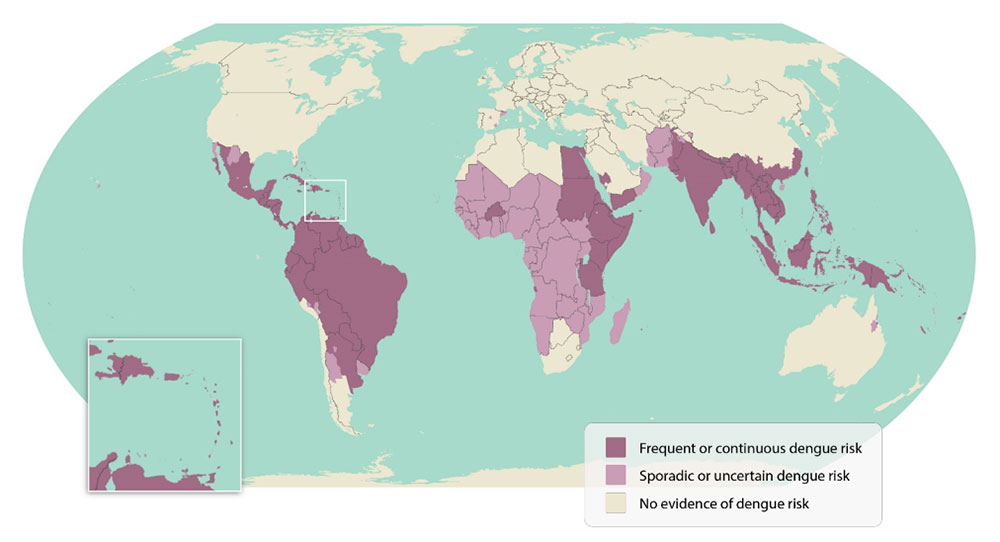
During 2018 the first locally acquired dengue cases were reported, with transmission occurring in the provinces of Cádiz, Catalonia and Murcia. Risk is low.
Dengue_Factsheet_Public_ECTM_IT.pdf
Insect_and_Tick_Bite_Protection_Factsheet_Public_ECTM_IT.pdf
In 3 casi su 4, l'infezione con il virus rimane asintomatica. Dopo un breve periodo di incubazione (5-8 giorni), 1 persona infetta su 4 presenta una brusca insorgenza di febbre, mal di testa, dolori articolari, agli arti e ai muscoli, oltre a nausea e vomito. È tipico anche il dolore durante i movimenti oculari. L'eruzione cutanea si manifesta di solito il 3° o il 4° giorno di malattia. Dopo 4-7 giorni, la febbre si riduce, ma la stanchezza può persistere per diversi giorni o settimane.
In rari casi, la dengue può essere grave. Particolarmente sensibili sono i bambini e gli anziani che vivono in regioni endemiche, così come le persone che hanno avuto una precedente infezione da dengue. I turisti presentano molto raramente una dengue grave. Nei primi giorni, la dengue severa assomiglia al decorso della classica febbre dengue, ma al 4°/5° giorno, di solito dopo che la febbre si è abbassata, le condizioni peggiorano. La pressione arteriosa si abbassa e i pazienti lamentano mancanza di respiro, disturbi addominali, epistassi e lievi emorragie cutanee o mucose. Nei casi più gravi, può presentarsi uno shock potenzialmente letale.
Non esiste un trattamento specifico per l'infezione da virus dengue. Il trattamento si limita alla mitigazione e al monitoraggio dei sintomi: riduzione della febbre, sollievo dal dolore agli occhi, alla schiena, ai muscoli e alle articolazioni e monitoraggio della coagulazione e del volume del sangue. I pazienti con sintomi gravi devono essere ricoverati in ospedale.
Per la riduzione della febbre o del dolore, si consigliano rimedi con il principio attivo paracetamolo o acetaminofene (ad esempio Acetalgin® Dafalgan®). I farmaci contenenti il principio attivo acido acetilsalicilico (ad esempio Aspirina®, Alcacyl®, Aspégic®) devono essere evitati.
Una protezione efficace contro le zanzare durante il giorno e soprattutto al tramonto è la migliore misura preventiva:
Per ulteriori informazioni, consultare il foglio informativo "Protezione dalle punture di zanzare e zecche".
Nota sul vaccino contro la dengue Qdenga®:
La protezione costante dalle zanzare durante il giorno (vedi sopra) è ancora considerata la misura preventiva più importante contro la febbre dengue!
There is a risk of arthropod-borne diseases other than malaria, dengue, chikungunya or zika in sub-/tropical regions, and some areas of Southern Europe. These include the following diseases [and their vectors]:
Importante: le malattie sessualmente trasmissibili possono manifestarsi anche senza sintomi o con sintomi lievi. Anche se non ne sei consapevole, puoi contagiare altre persone. Anche in assenza di sintomi, dovresti consultare il medico se hai avuto rapporti sessuali non protetti con un nuovo partner o con più partner. Questo perché la diagnosi e il trattamento precoci sono importanti per prevenire la trasmissione e le complicanze derivanti da malattie sessualmente trasmissibili non curate.
Le IST possono essere diagnosticate durante una visita medica o esaminando le urine, una lesione, una vescica o un tampone prelevato dalla vagina, dal pene, dalla gola o dall’ano. Gli esami del sangue possono aiutare a confermare alcune diagnosi (epatite A, B e C, HIV e sifilide).
Il momento in cui si effettua il test è importante, poiché alcune infezioni potrebbero non essere rilevabili immediatamente dopo l’esposizione (finestra diagnostica). Per escludere un’infezione, i test per l’HIV e la sifilide dovrebbero di norma essere effettuati almeno 6 settimane dopo il contatto sessuale. Nel caso della clamidia e della gonorrea, i test dovrebbero essere effettuati almeno 2 settimane dopo il contatto. Ciò vale solo in assenza di sintomi.
Si tenga inoltre presente che in alcune destinazioni l’accesso a test e trattamenti affidabili potrebbe essere limitato.
Prima di partire:
Durante il viaggio:
Il vaiolo è stato riscontrato comunemente in Africa occidentale e centrale per molti anni, dove il presunto serbatoio - i piccoli mammiferi - è endemico. Esistono due tipi di virus del vaiolo delle scimmie, chiamati "cladi", che causano la malattia: il clade I in Africa centrale e il clade II in Africa occidentale. Dalla fine delle campagne di vaccinazione contro il vaiolo all'inizio degli anni '80, i casi di vaiolo sono aumentati, all'inizio lentamente e negli ultimi 5-10 anni in modo significativo, soprattutto nella Repubblica Democratica del Congo (RDC).
Nel 2022, una nuova sottoclade emergente del clade II è stata responsabile di un'epidemia globale che si è diffusa principalmente attraverso il contatto sessuale tra uomini che hanno rapporti sessuali con uomini. Ne è scaturita la prima emergenza sanitaria pubblica di interesse internazionale (PHEIC) dichiarata dall'OMS fino al 2023. Sebbene l'epidemia del clade II sia ora sotto controllo, continua a circolare in tutto il mondo.
Nel 2024, la continua diffusione dell'mpox clade I nelle regioni endemiche dell'Africa centrale, in particolare nella RDC, e l'emergere di una nuova sottoclade Ib nell'est della RDC e nei Paesi limitrofi hanno destato preoccupazione a livello globale e hanno spinto l'OMS a dichiarare una PHEIC per la seconda volta in due anni. L'attuale diffusione geografica della variante mpox clade Ib avviene per vie commerciali attraverso il contatto sessuale (ad esempio, le lavoratrici del sesso), seguita dalla trasmissione locale nelle famiglie e in altri ambienti (che sta diventando sempre più importante).
Trasmissione da animale a uomo
L'Mpox può diffondersi dall'animale all'uomo quando questi entra in contatto diretto con un animale infetto (roditori o primati).
Trasmissione da uomo a uomo
Il vaiolo si può diffondere da persona a persona attraverso uno stretto contatto fisico (sessuale e non) con una persona che presenta i sintomi del vaiolo. Le lesioni della pelle e delle mucose, i fluidi corporei e le croste sono particolarmente contagiosi. Una persona può infettarsi anche toccando o maneggiando indumenti, lenzuola, asciugamani o oggetti come utensili/piatti per mangiare che sono stati contaminati dal contatto con una persona con i sintomi. I membri della famiglia, gli assistenti familiari e i partner sessuali di un caso confermato di mpox sono a maggior rischio di infezione, così come gli operatori sanitari che trattano un caso senza un'adeguata protezione personale.
Il periodo di incubazione (tempo che intercorre tra l'infezione e la comparsa dei sintomi) varia da pochi giorni a 3 settimane. La Mpox provoca un'eruzione cutanea che può essere dolorosa, associata a linfonodi ingrossati e febbre. La febbre può iniziare già prima della fase esantematica. Altri sintomi includono dolori muscolari, mal di schiena e affaticamento. L'eruzione cutanea può essere localizzata o generalizzata, con poche o centinaia di lesioni cutanee. Colpisce principalmente il viso, il tronco, i palmi delle mani e le piante dei piedi. Può essere presente anche nelle aree genitali e sulle membrane mucose come la bocca e la gola. I sintomi durano in genere dalle 2 alle 4 settimane e la persona rimane contagiosa fino alla guarigione di tutte le lesioni (una volta cadute le cabine).
Le complicazioni includono infezioni batteriche secondarie, infezioni polmonari e cerebrali e coinvolgimento di altri organi, parto prematuro e altro. I bambini, le donne in gravidanza e le persone con un sistema immunitario debole sono più a rischio di sviluppare una forma grave di mpox.
La maggior parte delle persone affette da mpox guarisce spontaneamente e non necessita di un trattamento antivirale specifico. La gestione dell'assistenza consiste nell'alleviare il dolore e gli altri sintomi e nel prevenire le complicazioni (ad esempio, la superinfezione). Diversi trattamenti antivirali sono studiati in vari Paesi e possono essere utilizzati in studi o in situazioni cliniche secondo le raccomandazioni delle società mediche nazionali.
In caso di sintomi:
Precauzioni generali:
Vaccinazione:
Esistono diversi vaccini contro il vaiolo (ad esempio Jynneos®, produzione Bavarian Nordic). Il vaccino Bavarian Nordic è stato originariamente sviluppato per combattere il vaiolo, ma offre una protezione incrociata contro il vaiolo. In Svizzera, il vaccino Jynneos® è autorizzato da Swissmedic dal 2024. I gruppi a rischio (ad esempio, gli uomini che hanno rapporti sessuali con altri uomini o le persone transgender con più partner sessuali) possono essere vaccinati dal 2022 e questa raccomandazione rimane invariata (vedi raccomandazioni dell'UFSP). Alla luce della situazione epidemiologica in Africa nel 2024, il Comitato svizzero di esperti in medicina dei viaggi raccomanda la vaccinazione contro l'mpox per i professionisti che sono/saranno in contatto con pazienti sospetti di mpox in regioni endemiche/epidemiche o che lavorano in un laboratorio in cui è presente il virus (per gli aggiornamenti, vedi news).
Il rischio per la popolazione generale e per i viaggiatori (turisti) è considerato estremamente basso se vengono seguite le precauzioni generali di cui sopra e se la vaccinazione non è raccomandata.
0